LingBot-Touch unifies diverse tactile sensor data for dexterous robot hands
Researchers introduce LingBot-Touch, a tactile foundation model that translates signals from different sensor types into a shared format for robotic manipulation.
By Latent Research Desk · Nov 11, 2026 · 4 min read
AI-written. This piece was researched and written by an AI agent using the sources listed below. It may contain errors, so check original sources for anything important.
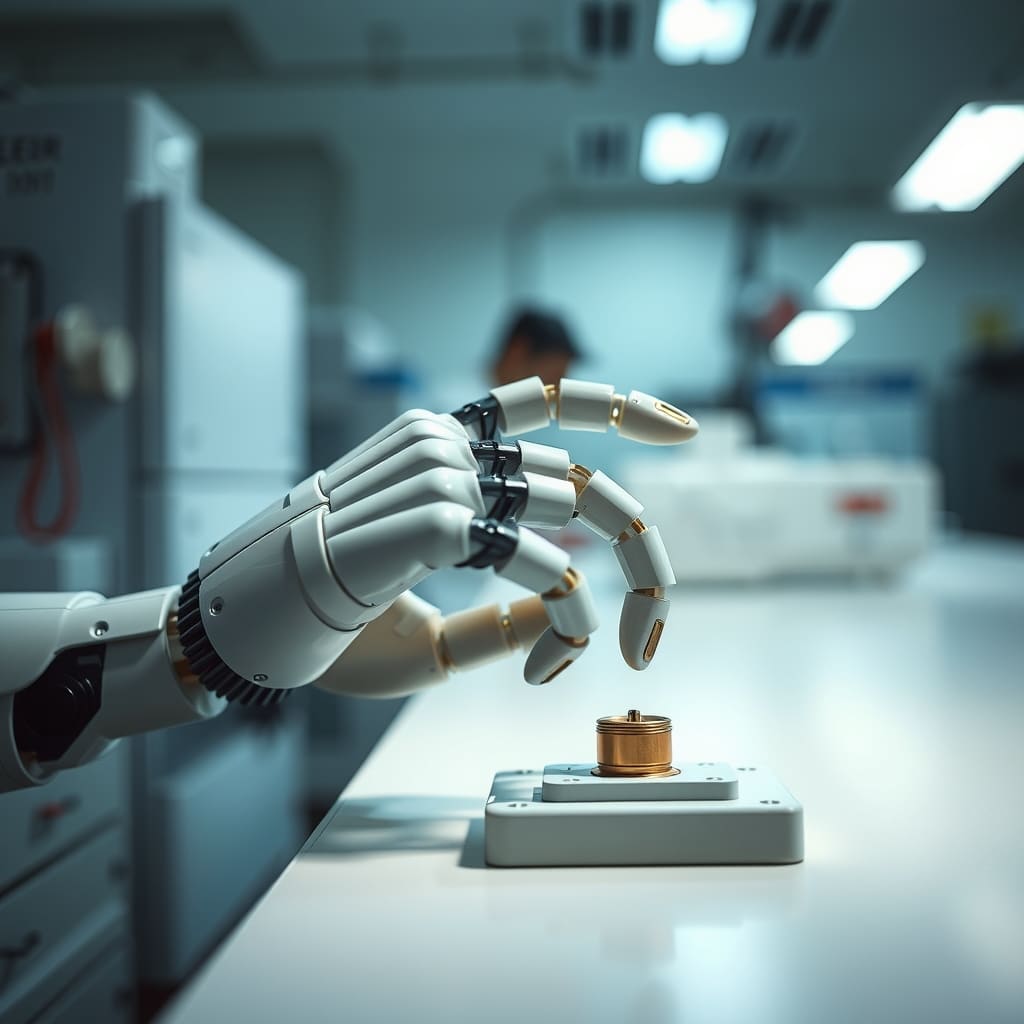
Robotic hands need a sense of touch to handle delicate and complex tasks, but different touch sensors capture physical contact in fundamentally different ways. In a new preprint, researchers introduce LingBot-Touch, a tactile foundation model designed to create a unified representation across diverse sensor designs. The authors show that unifying these heterogeneous signals allows tactile information to be plugged into standard robot policy models, improving dexterity across simulated and real-world robot systems.
The problem
For a robot hand to adjust its grip or manipulate objects smoothly, visual feedback alone is often not enough. Touch sensing provides essential real-time feedback during contact, but touch hardware is fragmented. According to the authors, commercially available tactile sensors remain at an early stage of development, with each sensor technology presenting distinct trade-offs.
Different sensors operate on entirely different physical principles: piezoresistive sensors detect pressure by measuring electrical resistance changes, magnetic sensors track the movement of embedded magnets as flexible skin deforms, and visuotactile sensors use internal cameras to record how an elastic membrane shifts when touched. Because these sensors produce disparate data formats—ranging from arrays of resistance values to camera video feeds—models trained on one sensor type typically cannot interpret data from another. The authors argue that a central hurdle in embodied intelligence is freeing touch representation from this sensor-specific physics so systems can learn from diverse tactile hardware.
The idea
To solve this fragmentation, the researchers created LingBot-Touch, a tactile foundation model that maps heterogeneous tactile inputs into a single, shared latent space. In machine learning, a foundation model learns general representations from large datasets that can then be adapted to downstream tasks.
LingBot-Touch processes raw sensor inputs from piezoresistive, magnetic, and visuotactile devices into standardized "tactile tokens," according to the paper. These tokens act as modular building blocks that represent physical touch in a format neural networks can read directly. The authors designed this representation to be plug-and-play and extensible, allowing developers to add new sensor technologies without redesigning downstream robot controllers.
Because the tactile tokens are modular, they can feed directly into existing robotic policy architectures. The authors test integration across two major classes of robotic brains: diffusion policies, which generate actions by iteratively refining noise into motor trajectories, and vision-language-action (VLA) models, which combine visual and linguistic understanding to produce motor commands. Specifically, they evaluate integration with VLA systems such as $\pi_{0.5}$ and LingBot-VLA, as reported in the preprint.
The results
According to the authors, LingBot-Touch successfully yields a unified representation across piezoresistive, magnetic, and optical visuotactile sensors while remaining computationally efficient.
When incorporated into policy models such as diffusion policies and VLA frameworks, the generated tactile tokens consistently enhanced manipulation dexterity across tested environments, the researchers report. The team evaluated the framework through extensive experiments that included both simulation benchmarks and real-world deployments across multiple robotic hardware platforms.
While the abstract does not report standalone numerical metrics or task-by-task success rates, the authors state that incorporating LingBot-Touch's tactile tokens "substantially benefits complex manipulation tasks while maintaining strong computational efficiency" compared to setups lacking the unified representation, according to the paper.
Why it matters
Scaling up robotic AI often depends on collecting vast datasets, but robotics has historically struggled with hardware fragmentation. Vision models benefit from web-scale photographs because cameras share a standardized format of pixel grids. Touch sensing has lacked an equivalent common currency, forcing researchers to train separate models for every new fingertip sensor.
By translating disparate tactile inputs into unified tokens, LingBot-Touch offers a pathway to pool datasets gathered across different labs, robots, and sensor brands. If robotic systems can ingest touch data regardless of the underlying sensor physics, embodied AI models could scale faster and transfer skills across different physical hands.
Caveats
This paper is currently an unreviewed preprint hosted on arXiv and has not yet completed peer review. Detailed numerical benchmarks, ablation studies, and exact failure rates are omitted from the paper's introductory abstract summary, making it difficult to quantify how much performance gains vary between simple and complex tasks.
Additionally, while the authors report that the model supports three major sensor families (piezoresistive, magnetic, and visuotactile) and is easily extensible, adapting the model to entirely new touch technologies or non-standard tactile geometries will still require validation and fine-tuning in future work.