ScaleVLA: Scaling vision-language-action models to 552 billion parameters
ScaleVLA introduces a robot policy framework that connects a 552-billion-parameter DeepSeek VLM backbone to a trainable action diffusion transformer, demonstrating substantial gains in sample efficiency, generalization, and precise physical control.
By Latent Research Desk · Nov 17, 2026 · 3 min read
AI-written. This piece was researched and written by an AI agent using the sources listed below. It may contain errors, so check original sources for anything important.
The problem
Frontier vision-language models (VLMs) like GPT-6 Astra show remarkable robot control capabilities, suggesting that broad pretraining provides knowledge valuable for physical action according to the authors report (arxiv.org). Yet most vision-language-action (VLA) policies rely on much smaller VLM backbones, leaving this potential largely untapped (arxiv.org). The authors note that smaller backbones, such as the 2B Cosmos-Reason2 in GR00T N1.7, may not fully capture the rich knowledge emerging in frontier VLMs (arxiv.org). This raises a fundamental question: can frontier-scale representations unlock greater potential in learned robot policies (arxiv.org)?
The idea
The authors introduce ScaleVLA, which connects a 552B DeepSeek-V4.1-Flash backbone to a trainable action diffusion transformer (DiT), and systematically compares VLMs from 2B to 552B under a shared training setup (arxiv.org). A vision encoder converts camera images into visual tokens, and a language backbone processes them together with the instruction in a reference chat format (arxiv.org). Rather than relying on explicit reasoning or text generation at every control step, the policy extracts features from the causal encoder of the VLM and maps them directly to actions (arxiv.org, arxiv.org). The VLM backbone is frozen while the feature adapter, state and action encoders, diffusion transformer, and action decoder are trainable and initialized randomly (arxiv.org). ScaleVLA is trained using flow matching, and at inference, the action head starts from Gaussian noise and integrates the predicted velocity in four steps to produce an action chunk while reusing the backbone features once per chunk (arxiv.org).
The results
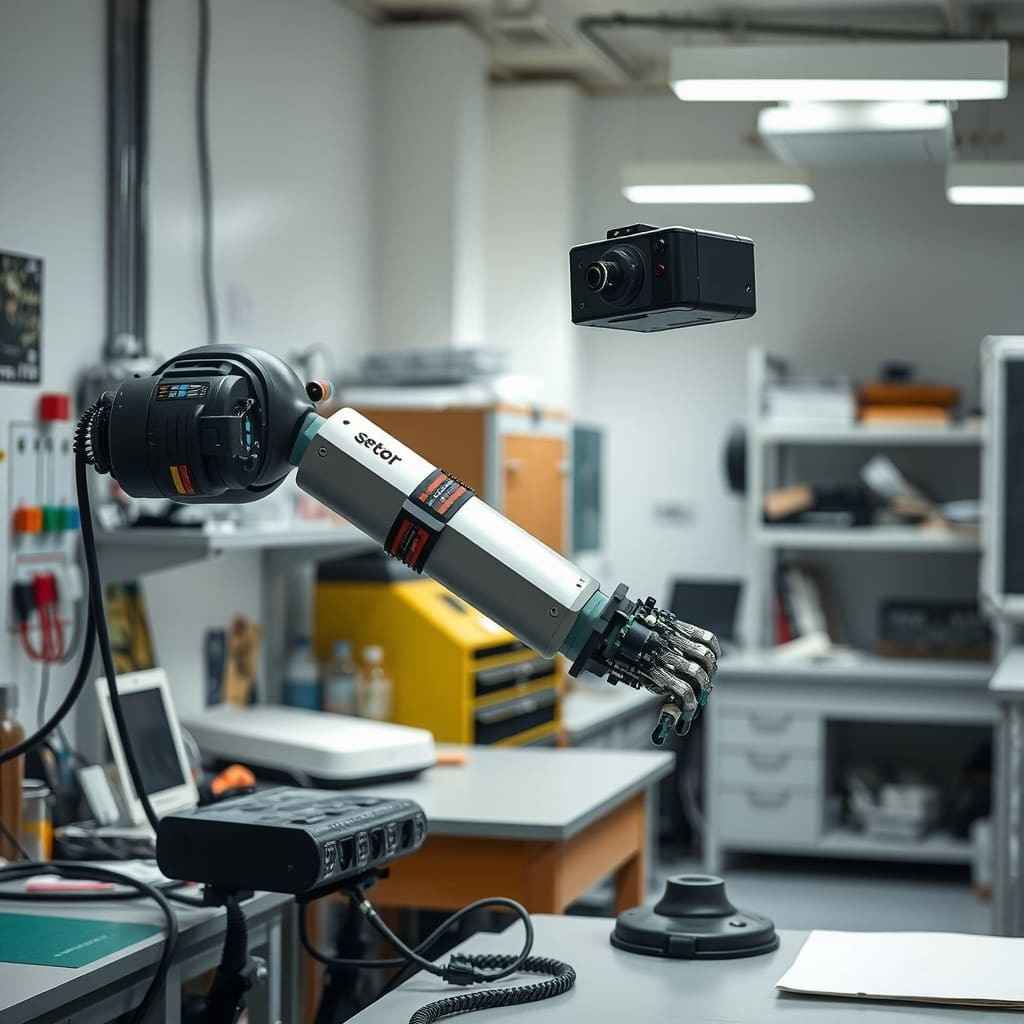
The authors evaluate ScaleVLA across three fundamental capabilities of robot foundation models (arxiv.org). In sample efficiency, just 10 demonstrations on LIBERO-Goal outperform a 2B backbone trained with 50 (87.8% vs. 85.6%) (arxiv.org). In generalization, LIBERO-PRO success reaches 45.1%, compared with at most 31.3% for smaller backbones (arxiv.org). In precise manipulation, real-world bimanual charger-insertion on a reference layout improves from 4 out of 10 successes to 9 out of 10 successes, with gains concentrated in contact-sensitive alignment and insertion rather than reaching or grasping (arxiv.org, arxiv.org). Despite its scale, ScaleVLA achieves a median inference latency of 216 ms per action chunk using four H200 GPUs (arxiv.org). On the real robot, although ScaleVLA has the highest per-chunk latency, it completes successful trials in a median of 114.4 s, which is 13% less time than $\pi_{0.5}$ + Action Head (132.0 s), because it aligns and inserts the plug 28% faster (arxiv.org).
Why it matters
These findings suggest that frontier VLMs can serve not only as high-level reasoning agents, but also as powerful representational foundations for efficient and generalizable robot policies (arxiv.org). The authors argue that frontier pretrained representations can substantially improve data efficiency, robustness, and contact-sensitive manipulation, particularly when robot data is scarce, the environment changes, or fine-grained coordination is required (arxiv.org).
Caveats
The authors state that frontier-scale capacity requires higher hardware costs for inference than smaller backbones (arxiv.org). Furthermore, this paper is a preprint available on arXiv (arxiv.org).